Product Marketing Portfolio: NDA-Safe Examples and Formats
What goes in a product marketing portfolio when your real work is under NDA: six artifacts, the public substitute for each, real examples and the format to pick.
Most of what a product marketer produces cannot leave the company that paid for it. The battlecard lists a rival’s weak spots, the launch plan carries targets for work that has not shipped, and the messaging doc was approved for one product at one moment. So a product marketing portfolio, for anyone already doing the job, is built mostly from substitutes.
The substitute is the stronger exhibit, as long as it is built honestly. A battlecard rebuilt from two public products lets a hiring manager open every source and test your reasoning; a scrubbed internal copy asks them to trust numbers they cannot see. Which artifacts to build in the first place is step 4 of my guide to becoming a PMM. This page covers the harder case: the originals exist, and you cannot show them.
What Is a Product Marketing Portfolio?
A product marketing portfolio is a short collection of work samples that shows a hiring manager how you position a product, launch it, equip sales and prove impact; four to six samples is a workable size. When the originals are under NDA, each sample is a substitute rebuilt on public information or a fictional company.
The six samples, each in its NDA-safe form:
- A positioning and messaging doc, rebuilt as a teardown of a public product
- A competitive battlecard for a fictional pair, or for two public products in a market you have never sold into
- A launch plan with targets written as relative changes instead of revenue
- A persona or customer insight brief built from public reviews or anonymized themes
- A sales enablement one-pager for the product you tore down
- A case study that is already published, or a fictional one labelled as fictional
One search note: “portfolio marketing” means something else. LaunchNotes defines a portfolio marketing roadmap as “a strategic document that outlines the marketing strategy for a portfolio of products or services” (LaunchNotes glossary). This page is about the job seeker’s portfolio. If you are still deciding whether to move into the role, my look at product marketing as a career covers pay and the career path from associate to VP.
Six Artifacts and Their NDA-Safe Substitutes
| Artifact | Why the original stays inside | NDA-safe substitute | What the hiring manager checks |
|---|---|---|---|
| Positioning and messaging doc | Names the competitive alternative, internal proof points and roadmap claims approved for one company | A teardown of a public product: its homepage claim, the alternative it implies, and the message you would test instead | Whether you name the competitive alternative and pair each message with proof |
| Competitive battlecard | Win themes, objection handling and pricing notes are what a rival would most want to read | A battlecard for a fictional pair, or for two public products, every claim linked and dated | Whether each “why we win” line is provable and the rival is described fairly |
| Launch plan | Dates, tiers, budgets and revenue targets for work that has not shipped | A plan for a hypothetical launch, or a past public one, with targets as relative changes such as “+20% trial starts” | Sequencing, named owners and a success metric chosen before launch day |
| Persona or customer insight | Interview notes and win-loss data belong to customers and the company | Anonymized themes with no names, dates or deal sizes, or a persona built from public reviews | Whether the insight changes a decision instead of describing a buyer |
| Sales enablement one-pager | Written for one sales team’s pipeline, pricing and objections | A one-pager for the teardown product, built from the same public sources | Whether a rep could use it on a call after two minutes of reading |
| Case study with metrics | Customer names and numbers need both the customer’s and the employer’s sign-off | A case study that is already published and linkable, or a fictional one with results as percentages | Whether you can separate what you did from what the team did |
Whatever the sample, expect to explain how you built it. Jenna Crane, listed on Sharebird as VP of Marketing at Triple Whale, writes: “Just make sure you can speak to the process of building those, because it’s impossible to know just from looking at them how much was built by the candidate vs. a collaborator” (Sharebird). A substitute you built alone, with its sources dated and a decision note on top, gives you that process to walk through.
How to Show Confidential Work in a Portfolio
Run every piece of work through two questions before it goes anywhere public.
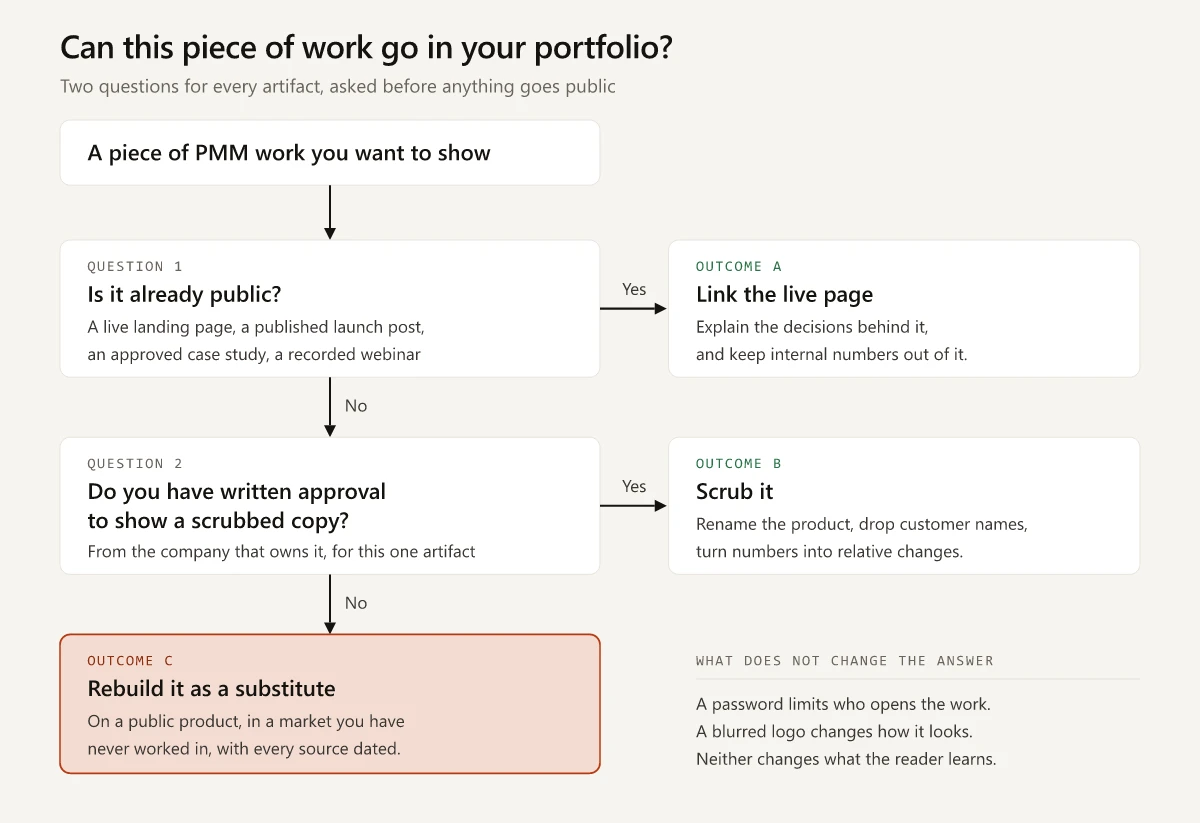
Devonshire, a recruiter for creative and marketing roles, lists six options in its guide to NDA-restricted portfolios. Three of them (generic case studies, hypothetical redesigns and asking permission) match the path above, and the last is a password: “a separate, password-protected section of your portfolio to share only with trusted individuals or during interviews” (Devonshire, October 2025). For product marketing work, a password does not solve the problem. The person typing it is a hiring manager at another company, possibly one in your category: the password limits who reads the battlecard, and that reader still learns every win theme in it.
The legal definition shows why the line sits where it does. Under US federal law, a trade secret covers business information, “including patterns, plans, compilations”, when the owner has taken “reasonable measures to keep such information secret” and the information gets its value from not being generally known (18 USC 1839). Win themes and launch targets can fit that description. Your NDA and employment agreement decide what applies to you, so read them before you pick an outcome in the diagram.
Scrubbing has limits too:
- Alex Gutow, listed on Sharebird as Head of Marketing at Arcade.dev, suggests a running doc of links to published work, with one reminder: “make sure these are externally published and that you’re not saving any internal materials from past jobs” (Sharebird).
- hexus.ai’s portfolio guide gives confidential work a single line: “consider creating anonymized versions or seeking permission to share” (hexus.ai). The diagram above asks for permission before any scrubbing, because a renamed product can still be traced to its company through a launch date or an exact figure.
Rules for Building a Substitute
- Pick a public product in a market you have never worked in, so nothing in the sample comes from inside knowledge. If the target job is in your current market, say in the note how the method carries over.
- Link and date every source: the pricing page, the docs, the changelog, the review site.
- Label it on the first line, for example “Fictional sample, built from public sources, October 2026”.
- Add a decision note of a few sentences: what you chose, what you cut and what you would test first. A fictional example, written for the battlecard generator’s first sample: “Acme Analytics leads against RivalCo on implementation time, two hours against two weeks, because RivalCo has more features and a feature count is a fight Acme loses. The integrations row is out: a count of 200+ says nothing about which ones this buyer needs. The implementation-time message gets tested first, on a comparison page.”
- Write results as relative changes and define each metric, so nobody mistakes a hypothetical for a past result.
Free Templates for the Substitutes
The generators on this site each have a “Load sample” menu that fills the form with fictional data, and each exports PNG or PDF. Treat the samples as placeholders and replace every value before the result goes near a portfolio.
| Substitute | Free template | First of its three fictional samples |
|---|---|---|
| Competitive battlecard | Battlecard generator | Acme Analytics vs RivalCo |
| Launch plan | Product launch plan template | Acme Insights v2, a Tier 1 launch |
| Persona | Buyer persona generator | Demand Gen Dana, VP of Demand Generation |
| Enablement one-pager | Product one-pager template | Acme Insights, a revenue attribution platform |
| Case study | Case study template | NorthWind Labs |
Product Marketing Portfolio Examples You Can Open
The two outside links were live on 3 October 2026; the last two rows are worked substitutes published on this site.
| Example | Format | What to copy from it |
|---|---|---|
| Susanna Bogardus, Marketing Portfolio | Canva presentation shared as a view link | Its writing and video samples shipped publicly (blog posts, product videos, a customer case study), and five of its seven product spotlights run ideation, build, internal release, external release and post release in order |
| Product Marketing (PMM) Portfolio by Stefanos Karakasis | Notion template, listed as free on Notion’s marketplace | A page you duplicate and fill, so the hours go into the samples instead of the layout |
| Competitive positioning map rebuilt from public evidence | Blog post with an editable SVG and CSV template | A positioning substitute on four public work management tools, each dot numbered to a dated source list printed on the chart |
| Messaging brief filled for the fictional Acme Insights | Blog post with a filled template | A messaging sample on a product labelled as fictional, including the claims the launch will not make |
The Bogardus portfolio follows outcome A for its writing and video samples: the deck links to the published pages. Its results are mostly percentages rather than dollar amounts; one relaunch spotlight reports a solution moving “from achieving 47% of sales targets to achieving 368% of sales targets”. Sales-target attainment is internal data, and the deck does not say whether that figure was cleared for release, so put any number like it through question 2 before you copy the move. Ross Gordon, listed on Sharebird as Senior Product Marketing Lead, Growth at Slack, made the same outcome A move with one live site: “When I was transitioning to a PMM, I would point my interviewers towards my company website. I led the project to overhaul it and wrote most of the copy” (Sharebird). He then backed it up with success metrics around the launch; if yours are internal, they go through question 2.
Product Marketing Alliance’s guide, which links the Bogardus deck, suggests, where possible, one example for at least four of seven categories, from positioning and messaging to customer education (PMA, Amelia Wilson and Bianca Stanescu, 15 September 2025). The Notion template is the one hexus.ai links.
Website, Notion, PDF or Deck: Pick a Format
A product marketing manager portfolio needs one link you can paste anywhere and one file you can attach. A product marketing portfolio website or a Notion page gives you the link; a PDF gives you the file.
| Format | Pick it when | Watch for |
|---|---|---|
| Personal website | You want one link for your resume, LinkedIn and email, and you will keep adding samples | Build and upkeep time. My guide to building a personal website with Claude Code covers the build, and the personal website examples gallery has 49 homepage concepts (as of October 2026) to borrow from |
| Notion page | You want it live today | Notion’s help center says Notion Sites lets you publish a portfolio, claim one notion.site domain and turn on search indexing; editing the SEO title and description needs a paid plan, and a custom domain needs a paid plan plus the custom domain add-on (Notion Help, as of October 2026) |
| A recruiter asks you to send samples. Julie Brown on Sharebird: “I am always asked to forward specific pieces of content or send links to my work. So have those pdfs and blog and video links handy.” | Links inside it go stale | |
| Slide deck | A panel round asks you to present your work | A deck covers one or two projects well; the Bogardus portfolio above shows a Canva deck shared as a view link |
A workable rule: keep one master copy on a website or a Notion page, and for each application export a PDF of the two samples that job description stresses most.
If your LinkedIn banner points visitors to the portfolio, keep that line clear of the profile photo and inside the area of the banner that desktop and the phone app both show.
Some PMM Interview Loops Use a Take-Home Instead
Not every interview loop asks for a PMM portfolio. Three Sharebird answers from PMM leaders, labelled 3y and 4y old on the site in October 2026, show how loops vary:
- Mike Berger, listed as a former VP of Product Marketing at ClickUp, SurveyMonkey, Gainsight and Marketo: “Maybe I’m unique but I’ve been in Product Marketing for a long time and I’ve never been asked to present a ‘marketing portfolio’. I have, on the other hand, been asked to present on specific topics or share specific experiences on many occasions.” (Sharebird)
- Holly Xiao, listed as Head of Content and Product Marketing at HeyGen: “For most interview processes, we’ll ask for work examples or have a homework assignment. So if you already have an online portfolio linked from your resume, that could save us a step.” (Sharebird)
- Yvonne Chow, listed as Director of Product Marketing at Zennify: “When I interview candidates, I find it a better use of everyone’s time and efforts to provide a case study that they can work on, within a specific context.” (Sharebird) In the same answer she writes that an online portfolio would not add weight to her decision.
When a loop includes a take-home, the take-home round in my product marketing interview questions guide covers how to handle it. In my view, the portfolio still earns a place as evidence for the rounds the take-home skips: a messaging assignment says nothing about launch planning, and your substitute launch plan does.
Start Your Product Marketing Portfolio With One Substitute
Pick the artifact your target job description weights most and rebuild it this week on a public product outside your current market, with every source dated and the decision note on top. A substitute a hiring manager can check line by line says more about your judgment than a scrubbed original they have to take on trust. Then publish it on your website or Notion page, so the next application can link it.
Frequently Asked Questions
What should be in a product marketing portfolio?
Four to six samples is a workable size, covering positioning and messaging, a competitive battlecard, a launch plan, customer insight, sales enablement and a case study with metrics. If the originals are confidential, rebuild each one on a public product or a fictional company and label it as a substitute.
How do you show confidential work in a portfolio?
Link it if it is already public, show a scrubbed copy only with written approval from the company that owns it, and otherwise rebuild it on public information. A password changes who sees the work and a blurred logo changes how it looks; neither removes the confidential content.
Do product marketing managers need a portfolio?
Not always. In Sharebird answers, Holly Xiao writes that for most interview processes her team asks for work examples or a homework assignment, and Yvonne Chow prefers giving candidates a case study to work on. Holly Xiao adds that a linked portfolio could save a step; it can also back up the rounds a take-home does not cover.
What is the best format for a PMM portfolio?
Keep one master copy on a personal website or a Notion page, and export a PDF of the two samples each job description stresses. Notion's help center says a Notion Site can publish a portfolio on a notion.site domain with search indexing on, while editing the SEO title and description needs a paid plan and a custom domain needs a paid plan plus an add-on.
Is there a product marketing portfolio template?
Notion's template marketplace lists a free Product Marketing (PMM) Portfolio template by Stefanos Karakasis. For the samples inside it, free generators for battlecards, launch plans, personas, one-pagers and case studies load fictional data that you replace with your own.