Product Launch Communication Plan: Who Hears It First (2026)
A product launch communication plan built on internal sequencing: the notification order with day offsets, a filled-in nine-audience matrix, and delay comms.
Picture launch morning. At 09:04 a customer success manager gets a message from her largest account asking whether the new usage limits apply to them, and she has never heard of the new usage limits. By 09:20 support has a queue of tickets about a pricing page that changed overnight and no macro to answer them with. At 09:40 an account executive on a discovery call is improvising an answer about a feature he found out about from the changelog eleven minutes ago. Nothing in that morning is an outbound failure, and every part of it is a product launch communication plan failure.
The blog post published on schedule. The email sent. The press release cleared legal. What broke is the order in which people found out, and the order is the part almost nobody writes down.
I opened the pages ranking for this term and read them end to end. Beamer’s runs five steps: define your target audience, determine your communication tactics, create a compelling message, prepare users for launch with a customer communication tool, and measure results. Userpilot’s runs thirteen steps split across pre-launch, launch and post-launch. Different counts, same shape. Both describe the axes of a grid and leave you to build the grid, and neither one sequences the internal audiences against each other, gives support, customer success and sales their own day offsets, or says a word about what you send when the date moves. That is the whole argument of this post: this is an internal sequencing job whose deliverable is a filled-in grid, not an outbound broadcast schedule with a calendar attached.
Product Launch Communication Plan Steps: The Short Version
A product launch communication plan sets who hears about a launch, through which channel, from which owner, and how many days before or after go-live. Build it in seven steps:
- Set the launch tier (Tier 1, 2 or 3) before writing anything, because the tier decides how deep every other step goes.
- List every audience, internal first: support, customer success, sales, executives, then beta users, existing customers, prospects, press and analysts, and community.
- Fix the notification order and give each audience a day offset from launch day (D-0).
- Assign one owner per audience. A named person.
- Pick one channel and one sentence per audience so the message survives being repeated by people who did not write it.
- Build assets backwards from the earliest date, which is almost always support enablement.
- Write the slip protocol before you need it: who gets told first if the date moves, and what never goes out.
Steps 3 and 7 are the two that neither of the pages above covers. They are also the two that decide whether launch week is calm.
What a Product Launch Communication Plan Has to Contain
Strip out the theory and a working plan is a short document with eight things in it. If a section does not resolve into a name and a date, it is commentary.
- The launch tier, written down and dated, so it can be defended when scope creeps in week three
- The audience list, internal teams listed above external ones on the page, because the page order becomes the send order
- A day offset for every audience, expressed relative to D-0 rather than as calendar dates that go stale the moment the date moves
- One named owner per audience, with a named backup for anyone who might be on a plane on launch day
- One channel per audience, chosen for where that group already reads things
- The one-sentence message every audience version has to contain, which is where your messaging pillars earn their keep
- The escalation path for launch day: who decides to pause, who can edit live copy, and which channel that decision happens in
- The slip protocol, covering who is told first and what is never said, drafted while nobody is panicking
Two things belong in the plan that people usually forget. The first is a freeze calendar. GitLab publishes its New Product Introduction process openly, and the “when we need to launch” input explicitly includes internal factors such as field blackout periods, month, quarter and year end financial close, and quiet periods. Those windows are real constraints on a comms plan, and they are invisible to anyone who only thinks about the outbound calendar.
The second is a kill list: the audiences you have deliberately decided not to contact, written down with the reason. An unlisted audience looks identical to a forgotten one when someone asks why the partner team was not told.
Product Launch Internal Communication: The Notification Order
This is the spine. Every audience in a launch gets a position in a queue, and the position is set by how long that team needs to be useful, not by their seniority.
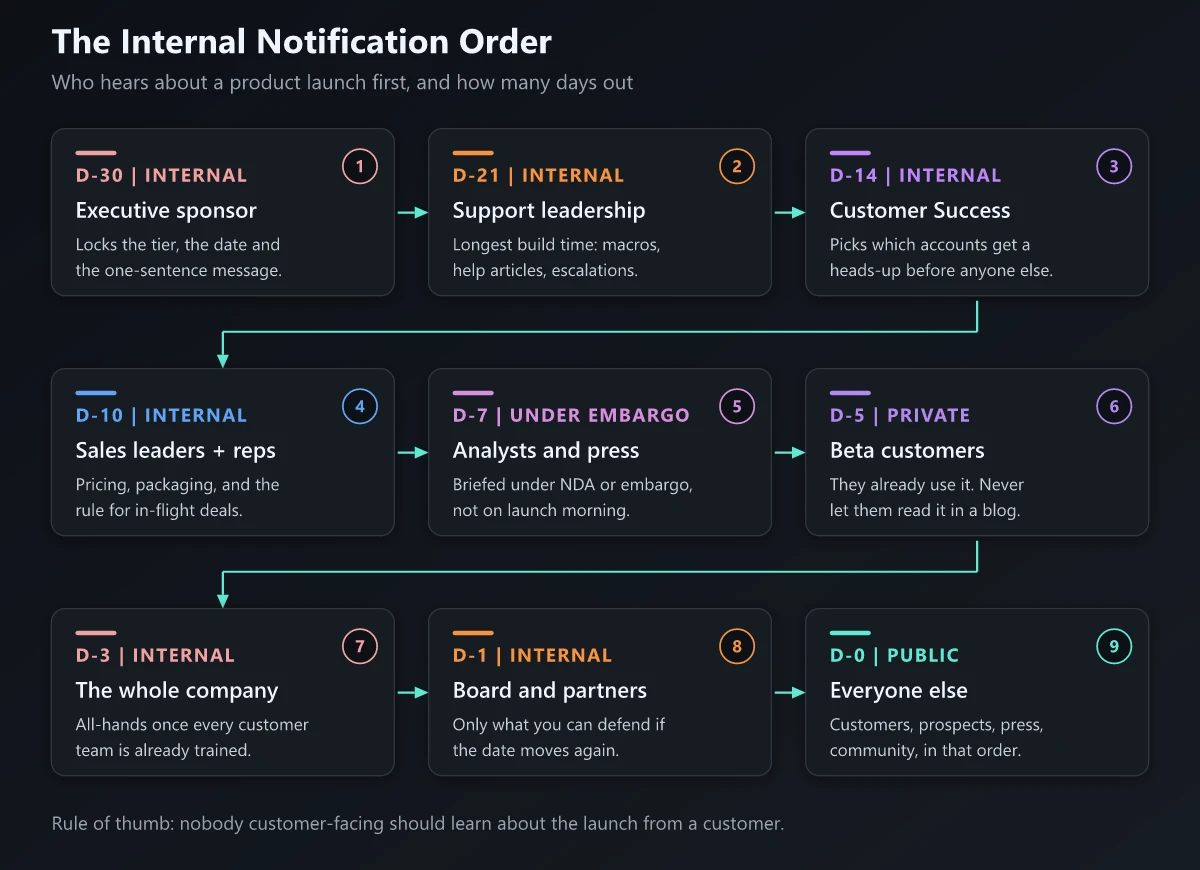
| When | Who hears | Why they sit here |
|---|---|---|
| D-30 | Executive sponsor and function leads | They lock the tier, the date and the one-sentence message. Everything downstream inherits those three decisions. |
| D-21 | Support leadership | Longest build time of any team: macros, help center articles, escalation paths, and a triage plan for the ticket spike. |
| D-14 | Customer success managers | They need time to decide which named accounts get a personal heads-up, and to book those conversations. |
| D-10 | Sales leadership, then reps | Pricing, packaging, the demo, the objection list, and the rule for deals already in flight. |
| D-7 | Analysts and press, under embargo | Their calendars, not yours, set this date. |
| D-5 | Beta and design partners | They already use the thing. Finding out via a public blog post reads as a downgrade in status. Which of them you owe what depends on which early-customer program you actually ran. |
| D-3 | The whole company | An all-hands or written post lands well once every customer-facing team is already trained, and badly before that. |
| D-1 | Board, investors and partners | Late enough that the date is real, early enough that nobody is surprised. |
| D-0 | Everyone else | Customers, prospects, press, community, in that order, on the hour. |
Three of those positions get argued about every time, so here is the reasoning.
Support before sales. Support has the longest asset build time and the shortest reaction window. A rep who is a day behind loses a little credibility in one conversation. A support queue that is a day behind generates a public backlog, a spike in first-response time, and a set of wrong answers that get screenshotted. Support also cannot triage what it has not seen, and macros need writing, reviewing and loading before the first ticket arrives.
Customer success eleven days ahead of the company. That gap is not about seniority, it is about a specific piece of work only CSMs can do. In the D-14 window their job is triage: read the change against every account on their book and sort it into three piles. The accounts who will not notice. The accounts who need one line in the next scheduled check-in. And the small number for whom this change is a problem, who need a call booked before D-0 rather than an email after it. That sort takes days of account-by-account judgment, and it cannot start from a slide seen at the same all-hands everyone else attended. If you have a formal customer enablement motion, D-14 is when it starts, not D-0.
Executives before the board. The exec sponsor is at D-30 because they own the tier decision and the date. The board is at D-1 because a board deck is a durable artifact that circulates, and because a date shared with a board is a date you have committed to twice. If your company is public, that gap is also where legal and investor relations get their say, and they need the date before they need the narrative.
One row on that list sets your date for you. Gartner states that lead times for accepted vendor briefings are typically scheduled two to four weeks out, and stretch further around industry events. That is a booking constraint, not a comms preference, which is why analyst relations has to be a standing cadence rather than something you switch on at D-7.
The same sequencing problem turns up in announcements that ship no product at all. A rename is the clearest case, and the running order is sorted on a different axis: in a rebranding rollout plan the queue is ordered by contract value and renewal timing rather than by how long a team needs to get ready, because the risk being managed is a customer’s procurement process rather than a support queue. Same spine, different sort key. If you can build one, you can build the other.
The Launch Comms Matrix: A Launch Communication Plan Template
Here is the grid, filled in. Nine audiences, three launch tiers, and a channel, an owner and a day in every single cell.
| Audience | Tier 1 | Tier 2 | Tier 3 |
|---|---|---|---|
| Support | Live enablement session plus macros / Support lead / D-21 | Written brief plus macros / PMM / D-10 | Changelog link in the support channel / PMM / D-2 |
| Customer success | Live walkthrough plus named account list / PMM and CS lead / D-14 | Written brief plus outreach template / PMM / D-7 | Release note in the CS channel / PMM / D-2 |
| Sales | Certification, battlecard and demo / Sales enablement / D-10 | Deck and talk track in the team meeting / PMM / D-7 | One-slide FAQ in the sales channel / PMM / D-1 |
| Executives and board | Pre-read and dry run, board summary at D-1 / PMM lead / D-30 | Written summary / PMM / D-7 | Line in the monthly product digest / PMM / D+7 |
| Beta and design partners | Personal email from their PM / Product manager / D-5 | Group email / Product manager / D-3 | In-app note / Product manager / D-0 |
| Existing customers | Email, in-app, webinar and docs / Lifecycle marketing / D-0 | Email plus in-app / Lifecycle marketing / D-0 | In-app plus release notes / Product / D-0 |
| Prospects and pipeline | Nurture track plus rep outreach / Demand gen and AEs / D+1 | Nurture email / Demand gen / D+2 | No outbound, website copy only / PMM / D-0 |
| Press and analysts | Embargoed briefings plus release / AR and PR / D-7 | Analyst note, no press push / AR / D-3 | No outreach, changelog is the record / PMM / D-0 |
| Community | AMA, forum post and Discord or Slack / Community manager / D-0 | Forum post / Community manager / D-0 | Changelog entry / Product / D-0 |
Three rules for using it. Replace every role with a human name before the plan is real, because “PMM” cannot be paged at 08:00. Read the grid down the tier column you actually picked and delete the other two, so nobody works from a version that includes a webinar you are not running. And treat “no outreach” cells as decisions, with the reason recorded next to them.
The customer email row tends to absorb effort out of proportion to its weight, mostly because it is the one cell that already has a template sitting somewhere. Make it a sequence rather than a single send, then move your attention up the grid: the structure in this product launch email sequence maps cleanly onto the D-0 and D+1 cells above.
Here is the same grid as a plaintext block. Paste it into the launch doc, fill the owner column with names, and delete the tiers you are not running.
PRODUCT LAUNCH COMMUNICATION PLAN

Product:              ______________________
Launch tier:          T1 / T2 / T3
Launch date (D-0):    ______________________
Comms owner (DRI):    ______________________
One-sentence message: ______________________
Freeze windows:       ______________________

AUDIENCE             | CHANNEL                       | OWNER | WHEN | DONE
---------------------|-------------------------------|-------|------|-----
Executive sponsor    | Pre-read + dry run            |       | D-30 |
Support              | Live session + macros         |       | D-21 |
Customer success     | Walkthrough + account list    |       | D-14 |
Sales                | Certification + battlecard    |       | D-10 |
Press and analysts   | Embargoed briefing            |       | D-7  |
Beta partners        | Personal email from the PM    |       | D-5  |
Whole company        | All-hands or written post     |       | D-3  |
Board and partners   | Written summary               |       | D-1  |
Existing customers   | Email + in-app                |       | D-0  |
Community            | Forum post + AMA              |       | D-0  |
Prospects            | Nurture + rep outreach        |       | D+1  |

IF THE DATE SLIPS
Told first (same day):  ______________________
Public correction goes: on the original post, dated
Never goes out:         a second date nobody has signed off
Launch Tier Comms: Scaling Depth to Launch Size
A dot release and a platform launch do not get the same plan, and the fastest way to burn out a launch team is to pretend otherwise. Tier the launch by how much behavior has to change.
| Tier | What qualifies | Comms notification lead time | External surface | Sign-off |
|---|---|---|---|---|
| Tier 1 | New product, new category, or a pricing and packaging change the CEO will be asked about | 30 days | Press, analysts, webinar, campaign, keynote | CEO or the exec sponsor |
| Tier 2 | A notable feature that changes what you sell or how you demo it | 10 to 14 days | Blog, email, in-app, sales enablement refresh | VP of product marketing |
| Tier 3 | An incremental improvement that changes nothing about the sale | 2 to 3 days | Changelog, release notes, in-app | The PMM on duty |
Read that third column narrowly. It is the comms window only: the number of days between the first internal notification and D-0. It is deliberately much shorter than the total prep time for the launch. Total prep runs 8 to 12 weeks of PMM lead time for a Tier 1, 4 to 6 weeks for a Tier 2 and 1 to 2 weeks for a Tier 3, which is how the tiers are scoped in the product launch checklist. The comms window sits inside that. Positioning, pricing sign-off, asset production and analyst cadence all start weeks before the first person outside the launch team is told anything, which is the point: you notify people once there is something worth notifying them about, not on the day the project opens.
The trap in Tier 3 is assuming that small means silent. Whether a change needs notice depends on whether anyone has to do something differently, and the largest software vendors treat that as a formal commitment. Microsoft’s Message center documentation states that major updates are communicated at least 30 days in advance when an action is required, covering things like changes that might generate help desk calls or break existing customizations. Google Workspace splits releases into two tracks so that admins on the Scheduled Release track get new features at least one week after they are released to Rapid Release domains.
Neither of those is a launch anyone would call Tier 1. They are routine platform changes, and they still carry a published notice period, because the audience that has to act is a different audience from the one you want excited.
For Tier 3, the channel matters more than the copy. A dated public changelog like GitHub’s, updated several times a week, does the job that a blog post cannot: it is a searchable record customers can point at, and it is the thing your support team links to instead of writing a fresh explanation each time.
Launch Day: Four Gates
An hour-by-hour run of show looks reassuring and fails quietly, because it tells people when to act without saying what has to be true before they act. When something runs late, everyone downstream keeps to their own row anyway. Launch day only needs four gates, each one a named person saying yes in writing before anything downstream moves.
| Gate | The question it answers | Who answers it | Nothing moves until |
|---|---|---|---|
| Go or no-go, D-1 evening | Are we shipping tomorrow? | Exec sponsor | The word is in the launch channel in writing, not implied by silence |
| Really live, before any announcement | Can a logged-in customer see this, or only a flagged internal account? | Comms owner | One person has checked a real account and said so |
| Internal before external, before the blog | Do support, CS and sales have the asset links and the escalation path? | Comms owner | The internal note has gone out |
| First ticket read, midday | What are people asking that we did not answer? | Support lead | Any question asked twice is in the FAQ |
Gate two is the one teams skip, and it is the expensive one. Announcing a change that is live for internal accounts and not for customers converts a launch into a support incident within the hour.
Between the gates, the ordering is ordinary and you should set it to suit your own teams: product change first, internal note second, blog and embargo lift third, customer email and in-app after that, social and community last, prospect nurture the following morning. Argue about those timings as much as you like. The four gates are the part that is not negotiable.
Mobile launches need one extra gate, because the go-live minute is not yours. Apple states that on average 90% of submissions are reviewed in less than 24 hours, which is fast but not a scheduling guarantee. Plan the announcement against the moment the build is approved and released, and never against a review that has not come back yet.
Enablement assets built at D-10 go stale by D+3, when the first real objections arrive and none of them match the ones on the battlecard. Run a sales enablement checklist through the whole week instead of treating D-10 as one big drop.
Product Launch Delay Communication: What to Send When the Date Slips
Dates move. It is the one event a launch calendar should always be ready for, and it is the one event neither of the ranking pages I opened at the top of this post mentions anywhere. So here is the protocol.
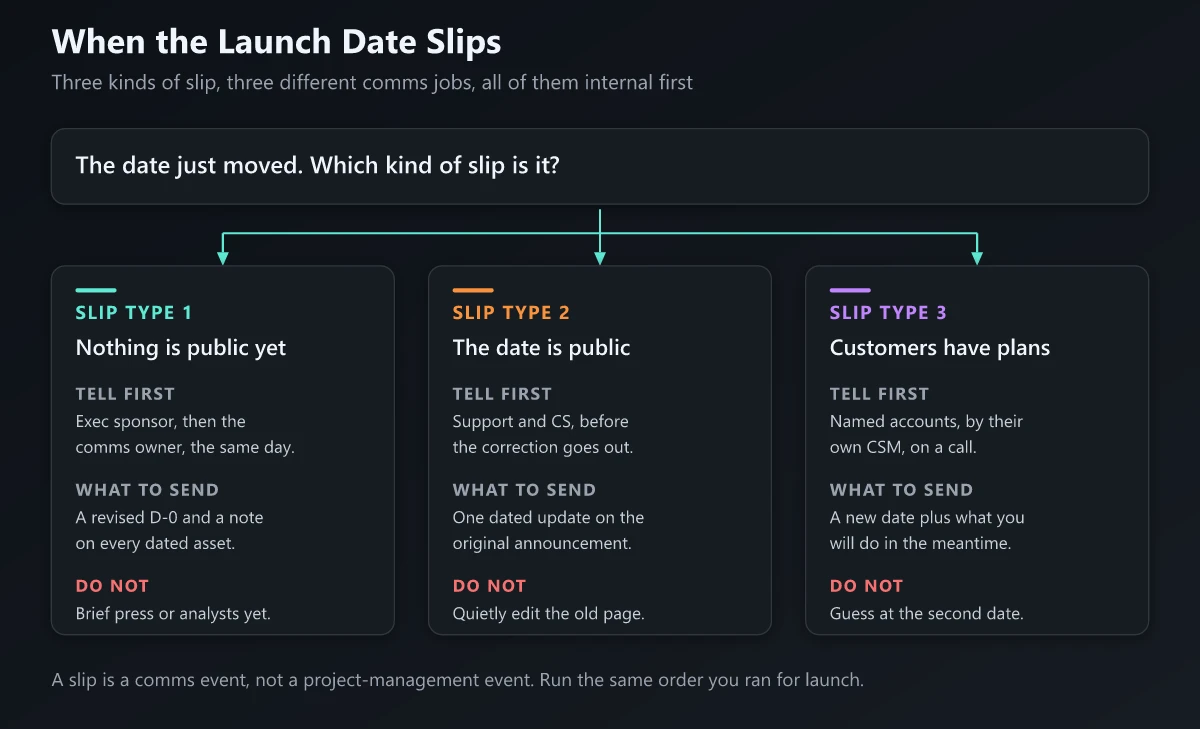
Start by classifying the slip, because the three types have almost nothing in common.
Type 1: no date is public. The cheapest kind. Tell the exec sponsor and the comms owner the same day, reissue the D-0 and let every day offset recalculate itself, and update anything already dated. Do not brief press or analysts yet, and resist the urge to send a company-wide note, because a slip that nobody outside the launch team knew about does not need a company-wide correction.
Type 2: the date is public. Now the internal order matters again, and it is the same order. Support and customer success hear first, with the holding line, before any public correction goes out. Then sales, with an explicit rule about what reps may say to deals in flight. Then the public update.
Type 3: customers have made plans around the date. Named accounts hear from their own CSM, on a call, before anything is published. A migration date, a procurement cycle or a launch of their own may be attached to your date. This is the only slip type where a written announcement is the wrong first move.
Do you name a new date, or no date at all?
This is the decision that gets made badly under pressure, usually by whoever is most uncomfortable with the silence. There is a test that settles it. You may name a new date when engineering has committed to it in the same tone they would commit to a customer, when the thing that caused the slip is fixed rather than being worked on, and when you have added the buffer you did not add last time. If any of the three is missing, you do not have a date, you have a hope, and publishing a hope costs you the credibility you are trying to protect.
When you cannot name a date, name the next checkpoint instead. “We will post an update by the last Friday of the month, with or without a date” is a commitment you can keep, and it converts an open-ended wait into a scheduled one. Then keep it, including on the months where the update says nothing has changed. The update nobody wants to send is the one that buys the trust.
| Audience | What to send | What never goes out |
|---|---|---|
| Support and CS | The new date, the holding line, updated macros | ”We do not have an update at this time” |
| Sales | The in-flight deal rule and exactly what may be promised | A second date that has not been signed off |
| Beta partners | A direct note from their PM with the real reason | Silence |
| Existing customers | One dated update, and only if they were given a date | A new announcement designed to change the subject |
| Press and analysts | A short factual note, only if they were briefed | A re-pitch of the same story with a new hook |
| Community | The same update, the same day as customers | A locked thread with no answer in it |
| Board and investors | Revised date and revenue impact, via the exec sponsor | Anything that has not been through legal |
The holding line, written before you need it
Every row in that table depends on one artifact: a single approved sentence that anyone customer-facing can say out loud without checking. Write it in the same session as the launch plan, while the date still looks safe, because the version drafted in the hour after a slip is always either too defensive or too specific. Keep the fill-in block in the launch doc.
SLIP HOLDING LINE

Slip type:            1 (no date public) / 2 (date public) / 3 (customers have plans)
Approved by:          ______________________
Date approved:        ______________________

The one sentence:     ______________________________________________
                      ______________________________________________

If asked "why":       ______________________________________________
If asked "when":      ______________________________________________
If pushed harder:     escalate to ____________, do not improvise

Reps may still:       ______________________________________________
Reps may not:         quote a new date, name a team, name a vendor
Expires:              ______________________ (rewrite, do not extend)
The expiry line is the one people leave blank and should not. A holding line has a shelf life measured in days. Left running for three weeks it stops sounding careful and starts sounding evasive, and the reps using it know that before you do.
Three public examples show the shape of a slip note that works.
Microsoft’s Recall preview kept its original blog post and appended dated updates to it. The Windows Experience Blog post from June 2024 carries an update dated June 13 moving the feature from broad availability to the Windows Insider Program, another dated August 21 moving it to October, and a third dated October 31 moving it to December. Three slips, one canonical URL, every change stamped. That is the right structure: the page a customer already bookmarked stays the page that tells them the truth.
Rockstar’s note moving Grand Theft Auto VI to Thursday, November 19, 2026 is four sentences long. It gives the new date in the first line, apologizes for the additional time, gives one reason, and stops. No roadmap, no compensating announcement, no explanation of what went wrong internally. Short is not evasive when the date is specific.
Google’s Privacy Sandbox post from April 2025 is the third variant, the one where the plan changes rather than the date. Anthony Chavez wrote that Google had “made the decision to maintain our current approach to offering users third-party cookie choice in Chrome, and will not be rolling out a new standalone prompt for third-party cookies,” and named the ecosystem disagreement as the reason. The full post is worth reading as a model for the hardest version of this message: we are not doing the thing we said we would do, here is what we are doing instead.
What never goes out externally, in any of the three: a second date you are not confident you can hold, a reason that names a team or a vendor, and a silent edit to the original page. A quietly changed date is the version customers find out about anyway, and it costs more trust than the delay did.
The second slip is a different message
A first delay is a scheduling event and most audiences absorb it. A second delay on the same launch is read as a signal about the product, and repeating the first message in a new font makes that reading worse. Three things change.
The reason has to get more specific, not less. The first note can say the work needs more time. The second cannot, because you already spent that sentence, and reusing it tells people you either do not know what went wrong or will not say. Name the category of problem, even if you will not name the team.
The sender moves up. A first slip goes out over the product or comms owner. A second should carry the name of whoever owns the launch outcome, because escalating the sender is the only signal available that you understand the difference between the two events.
And the date discipline tightens. The instinct after a second slip is to publish a third date quickly to close the story. Do the opposite. If you are naming a date at all, name one with enough buffer that a third slip is close to impossible, and if you cannot, go to the checkpoint commitment above. Microsoft’s Recall page is instructive precisely because it does this: three dated updates on one URL, each one a discrete acknowledgment rather than a fresh announcement, and no attempt to make any of them look like good news.
If the slip turns into a cancellation, that is a different document with a longer notice period, and the product sunset playbook is the closer fit.
What to Measure
Launch comms measurement usually starts at D-0, which is too late to change anything. Half of it belongs before.
Four readiness numbers predict launch week better than anything you can collect during it: the share of reps certified by D-5 rather than by D+7, the count of support macros loaded and tested against a real ticket, the number of named accounts with a CSM conversation already booked, and whether every cell in the matrix has a human name in it rather than a role.
After launch, measure the comms rather than the product, and treat one number as the headline: the share of support tickets in the first 72 hours whose answer already existed in a macro or the FAQ. A high ratio means the internal half of the plan worked. A low one means support was told too late, whatever the open rates say. Everything else, engagement by segment and changelog traffic, is context around that. For the wider set a launch rolls up into, the product marketing metrics breakdown covers what belongs on the quarterly view.
Changelog traffic is the weakest of those signals, and it is the one most teams over-read. Treating SaaS release notes as an adoption asset rather than a documentation chore changes both what goes in them and what you count afterwards, which is feature adoption among the people who read them.
The Bottom Line
A product launch communication plan is judged on the order people find out, not on the quality of the announcement. The announcement is the easy half, and it is almost never the thing that goes wrong. What goes wrong is a CSM reading about your launch from her own customer, a support queue with no macro, and a rep quoting a changelog entry on a live call.
So build it in that order. Pick the tier, list the internal audiences above the external ones, put a day offset and a human name on every row, fill in the grid, and write the slip protocol while the date still looks safe. Support at D-21, customer success at D-14, sales at D-10, the company at D-3, the board at D-1, and the world at D-0.
Everything external in a launch is recoverable. A blog post can be edited, an email can be resent, a press release can be followed up. The internal order gets exactly one attempt.
Frequently Asked Questions
What are the 7 steps of a product launch communication plan?
Set the launch tier, list every audience with internal ones first, fix the notification order with day offsets, assign one named owner per audience, pick one channel and one message per audience, build the assets backwards from the earliest date, and write the slip protocol before you need it. The tier decision comes first because it sets how deep every other step goes.
What is a 5 point communication plan?
A five point communication plan answers who, what, when, how, and who owns it for every audience. For a launch, the useful version adds a sixth point: what happens if the date moves. A plan that covers the first five and not the sixth breaks the first time engineering slips a week.
What should a product launch plan include?
A launch tier, a dated audience list covering internal teams before external ones, a named owner per audience, one channel and one message per audience, the assets each audience needs, an escalation path for launch day, and a written slip protocol. Anything that does not resolve into a name and a date is commentary rather than a plan.
What are the six steps of a product launch plan?
The usual six-step framing runs: define the audience, set positioning and messaging, pick channels, build assets, set a timeline, and measure results. That sequence is fine for the outbound half and silent on the internal half, which is where launches actually break. Sequence the internal notification order first, then hang the outbound steps off it.
How do you communicate a product launch delay?
Tell the internal teams who face customers before you correct anything publicly, in the same order you used for launch: support, customer success, then sales. If the original date was public, post one dated update on the original announcement instead of quietly editing the page. Never publish a second date you are not confident you can hold.