Feature vs Benefit vs Value: Tests, Examples and a Worksheet
Feature vs benefit vs value, told apart by where you check each line: a pass or fail test per tier, B2B examples from vendor docs, a worksheet and the FAB model.
Feature: This site’s UTM builder flags any utm_medium value that matches no default channel group.
Benefit: You fix the tag before launch, instead of finding paid clicks under Organic Social or Unassigned a month later.
Value: The paid social line in the monthly channel report gets credit for the sessions those clicks bring in.
Those three lines are feature vs benefit vs value applied to a single check in the free campaign name and UTM builder.
My view is that the three tiers are easiest to tell apart by where you would check each line (the tool’s own page, the user’s working week, a report the buyer already sends upward), and that tone is the wrong test. Shopify’s features vs benefits guide defines features as “the attributes and characteristics of the product itself”, and its FAQ sorts the two by tone: features “are factual and rational”, while benefits “reach consumers on an emotional level”. Indeed’s guide, updated in June 2026, has no value tier at all; value appears inside its definition of a benefit rather than as a tier of its own.
| Tier | Question it answers | One-line test | Example: Stripe Billing’s Smart Retries |
|---|---|---|---|
| Feature | What is it, or what does it do? | It names a capability or spec, not an adjective, that you can point to in the docs, spec sheet, pricing page or changelog | Smart Retries chooses when to retry a failed subscription payment |
| Benefit | What can the user now do, or stop doing? | It names a task from the user’s job, with a verb | The billing team stops chasing every failed payment by hand |
| Value | What is that worth to the buyer? | It names the change to a goal or number the buyer already reports on | Less involuntary churn in the monthly revenue review |
The benefit and value rows lean on Stripe’s own docs, which say Stripe Billing can “automatically retry failed subscription and invoice payments for you” and describe automatic retries as a way “to reduce involuntary churn” (Stripe docs, checked 2 October 2026).
What Is the Difference Between a Feature, a Benefit and Value?
A feature is what the product is or does, a benefit is what the user can now do or stop doing because of it, and value is what that change does to a goal or number the buyer already reports on.
The third tier earns its place when two people are involved. The user gets the benefit and the buyer signs for the value, so a page that stops at the benefit leaves the buyer with nothing to repeat to their own boss. The line that leads also changes with the reader while the feature underneath stays put, which the messaging pillars guide shows by flexing one pillar for a VP of Engineering and an individual developer. Inside a full brand messaging framework, feature lines become proof points under each pillar, and the value line is the raw material for a value proposition.
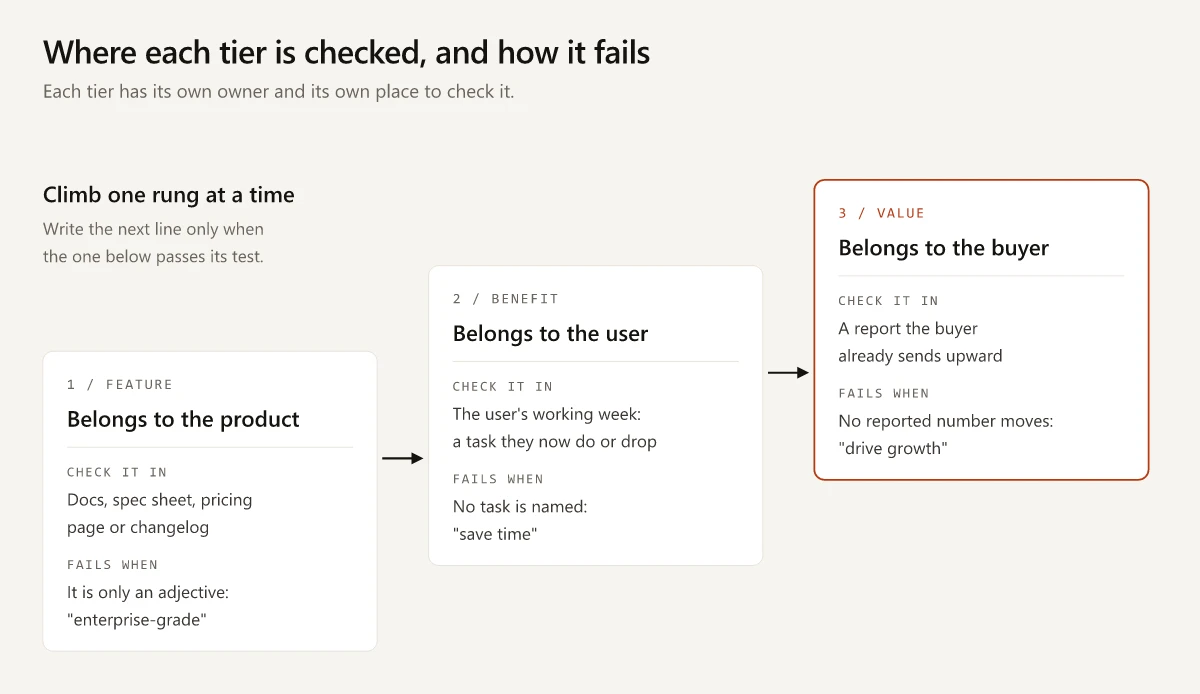
Feature vs Benefit vs Value: The One-Line Test for Each Tier
Run the tests in order, bottom rung first. A value line written on top of a failed feature line has nothing under it that anyone can check.
The Feature Test: Can You Point to It?
A feature line passes when it names a capability or spec rather than an adjective, and you can point to a page your company published that states it: the docs, a spec sheet, a pricing page or a changelog. Nobody outside the company has to be asked.
| Line | Verdict | Why |
|---|---|---|
| ”Using AI, Smart Retries chooses the best times to retry failed payment attempts” | Pass | Stripe’s billing docs, linked above, say it word for word, and they say what the AI decides |
| ”Enterprise-grade reliability” | Fail | No page can prove an adjective; an uptime figure in the contract could |
| ”the Monthly Uptime Percentage will be at least 99.9% in any calendar month” | Pass | The same reliability claim as a spec, stated on a page and backed by a contract |
| ”AI-powered insights” | Fail | It names a technology rather than a capability, since it never says which insights come out |
The passing uptime line is quoted from Google’s Workspace SLA, last modified 31 August 2026, which also sets service credits for any month that misses the figure.
The Benefit Test: Is There a Task in It?
A benefit line passes when it names a task from the user’s job, with a verb, that the user can now do or stop doing. Clicks, uploads and other steps inside the product do not count.
| Line | Verdict | Why |
|---|---|---|
| ”The billing team stops chasing every failed payment by hand” | Pass | Chasing failed payments is a recurring task in a named team’s week |
| ”Save time” | Fail | No task and no person |
| ”Upload your contacts and get a score” | Fail | Both verbs happen inside the product |
| ”Build a battlecard in 2 minutes” | Pass | Building a battlecard is a task from a product marketer’s job, and the time makes it specific |
The Value Test: Would the Buyer Report It?
A value line passes when it names the change to a goal or number the buyer already reports on, to a manager or a board. If the buyer would need a new dashboard to see the number, the line is describing your metric rather than theirs.
| Line | Verdict | Why |
|---|---|---|
| ”Less involuntary churn in the monthly revenue review” | Pass | Subscription finance teams already track churn, and Stripe names it as the goal |
| ”Two fewer days to close the books each month” | Pass | A controller already reports days to close |
| ”Drive growth” | Fail | No number and no buyer anyone could check |
| ”Build a battlecard in 2 minutes” | Fail | A number, though not one the buyer reports |
“Less involuntary churn in the monthly revenue review” is as flat as any spec line and still passes, which is why tone cannot sort the tiers. If you draft value propositions with the so-that template, the clause after “so that” is where a passing value line goes.
Features vs Benefits Examples From Four B2B Vendors
The feature cells below are quoted from each vendor’s help page as checked on 2 October 2026. The benefit and value cells are my rewrites. Each value cell names the number to put on the claim rather than a result.
| Product | Feature (vendor’s words) | Benefit (my rewrite) | Value (the change, and whose report) |
|---|---|---|---|
| Mailchimp Send Time Optimization | ”determine when your contacts are most likely to open your email within 24 hours of the date you select” | The email marketer stops picking a send hour for every campaign | More opens per send, in the email lead’s campaign report |
| HubSpot lead scoring | ”build custom lead scores based on record actions or properties” | Reps work the scored list from the top instead of sorting contacts by hand | A higher MQL-to-SQL conversion rate, in the demand gen lead’s pipeline review |
| Zendesk macros | ”a prepared response or action that an agent can manually apply when they are creating or updating tickets” | Agents answer a repeat question without retyping the reply | Faster first reply time, in the support lead’s weekly review |
| Google Ads Smart Bidding | ”use Google AI to optimize for conversions or conversion value in every auction” | The paid media manager stops setting bids keyword by keyword | Cost per acquisition held at target, in the weekly paid media report |
When the vendor’s own page names the goal, as Stripe’s does with involuntary churn, quote it. When it does not, the value line needs a customer number behind it before it ships.
The Feature Benefit Value Ladder Worksheet
The worksheet turns feature vs benefit vs value into three pass or fail checks. Copy it into a doc, fill one ladder per claim, and do not write a rung until the one below it passes.
FEATURE / BENEFIT / VALUE LADDER

Claim or capability:   ____________________________________________
User (touches it):     ____________________
Buyer (signs for it):  ____________________

1. FEATURE: what it is or does
   Line:   ______________________________________________________
   Test:   Does it name a capability or spec (not an adjective)
           that I can point to in our docs, spec sheet,
           pricing page or changelog?
   Where:  ______________________________      [ ] PASS   [ ] FAIL

2. BENEFIT: what the user can now do, or stop doing
   Line:   ______________________________________________________
   Test:   Does it name a task from the user's job, with a verb?
           (Clicks, uploads and other steps inside the product
           do not count.)
   Task:   ______________________________      [ ] PASS   [ ] FAIL

3. VALUE: what that is worth to the buyer
   Line:   ______________________________________________________
   Test:   Does it name the change to a goal or number this buyer
           already reports on?
   Report it appears in: ________________      [ ] PASS   [ ] FAIL

Owner check: the benefit line is about the user and the value
line is about the buyer. If they are the same person (a free
tool, a founder buying for herself), write that down. If not,
the value line is the one the buyer has to defend upward.
A Filled Example: The Battlecard Generator on This Site
| Tier | Line | Result |
|---|---|---|
| Feature | ”Add your product, competitor, and top differentiators, then download a polished, sales-ready battlecard PNG.” | Pass on the capability (three inputs in, a PNG out), which is the battlecard generator page’s own meta description; “polished” and “sales-ready” are adjectives the test cannot check |
| Benefit | Send reps an updated one-page card the same day a competitor changes its pricing page | Pass: the task is replacing a stale card |
| Value | A higher win rate against that competitor, in the quarterly sales review | Passes as a line, unproven as a result |
A team’s win rate against that competitor, read alongside its own win-loss analysis interviews, is where to check whether faster card updates made a difference.
The Same Ladder on a LinkedIn Headline
In September 2026 I rewrote my LinkedIn headline, and one line in it reads: “I write the brief, then I build it.” Run through the worksheet, it lands like this:
- Feature: the line itself, which passes because the free tools on this site are where anyone can check it.
- Benefit: a team stops waiting on a handoff between the person who writes the brief and the person who builds the page.
- Value: the reader’s to write. A head of marketing might count launch dates hit, and a founder might count weeks from brief to live page.
Running the Test on This Site’s Nine Tool Taglines
I ran the three tests on the hero tagline at the top of each of the nine live free tool pages on this site, as published on 2 October 2026, and none of the nine reaches the value tier. I scored each tagline by the highest tier any of its sentences reaches. A tagline that only lists what goes in and what comes out describes the product, so it scores as a feature.
| Tier the tagline reaches | Tools | Example tagline |
|---|---|---|
| Feature | 2 | UTM builder: “Four fields in. A campaign name and its matching UTM string out.” |
| Benefit | 7 | Battlecard generator: “Build a polished, sales-ready competitive battlecard in 2 minutes.” |
| Value | 0 | No tagline names a number a buyer reports |
All seven benefit-tier taglines open with “Build” and put a time in minutes on the task, which is a number from the user’s week rather than the buyer’s report.
For a free tool, the user and the buyer are the same person and there is no budget to defend, so a tagline that stops at the benefit costs less there than one on a paid product’s pricing page. The UTM builder’s value line already exists, as the third line at the top of this post, while its tagline stops at the feature.
Features vs Advantages vs Benefits (FAB)
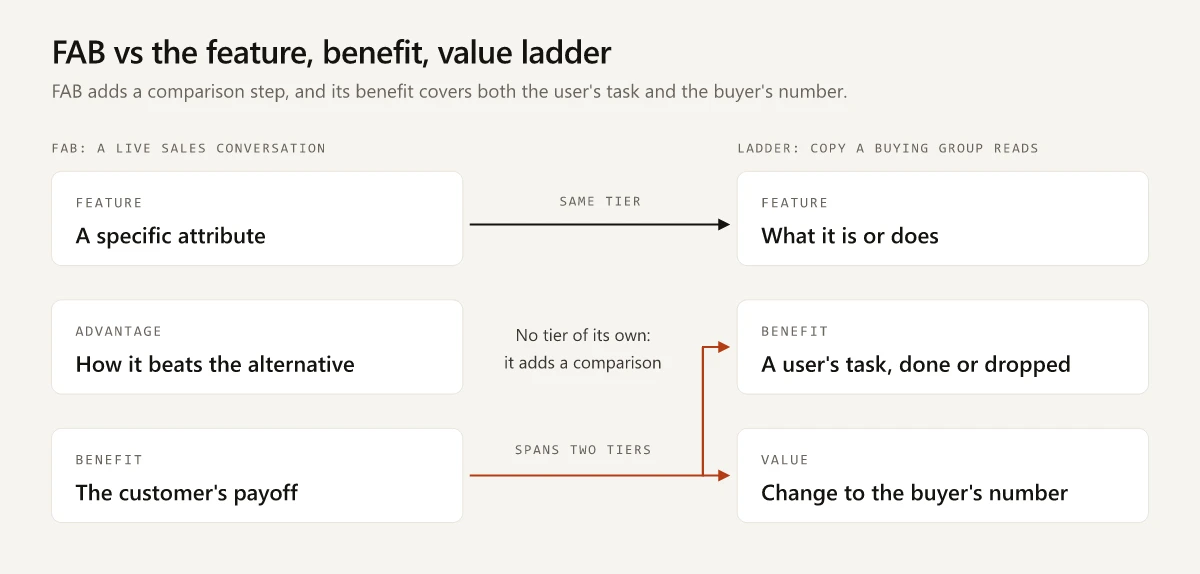
FAB is the version of the ladder built for sales conversations. Clay’s glossary entry on the FAB technique defines its three parts in one sentence: “A feature is a specific attribute of the product, an advantage explains how that feature provides a superior outcome, and a benefit is the personal value the customer receives.”
| FAB step | Closest tier on the ladder | What changes |
|---|---|---|
| Feature | Feature | Nothing: same tier, same point-to-it test |
| Advantage | No tier of its own | It adds a comparison with the alternative the buyer uses today |
| Benefit | Benefit and value, merged | One payoff slot, which Clay fills with a personal gain (user productivity) or a business outcome (higher revenue), with no separate line for a buyer who is not the user |
Clay’s worked example is “a faster processor (feature) allows smoother multitasking (advantage), boosting user productivity (benefit).” Boosting productivity names no task and no reported number, so it fails both the benefit test and the value test. The same three steps for Smart Retries, written from the Stripe docs linked above, show what the merge loses:
| FAB step | Smart Retries, written as FAB |
|---|---|
| Feature | Smart Retries chooses when to retry a failed subscription payment |
| Advantage | Where a custom schedule waits a set number of days between retries, Smart Retries times each one from time-dependent signals to raise the chance the invoice gets paid |
| Benefit | Fewer failed payments to chase, and less involuntary churn |
On the ladder, that FAB benefit becomes two lines: the billing team’s task and the churn number in the monthly revenue review.
Pick the model by who is listening:
| Situation | Use | The line that does the work |
|---|---|---|
| A live sales call where one person evaluates and signs | FAB | The advantage, since a live buyer is weighing you against what they use today |
| A pricing page, one-pager or RFP answer that a buying group reads with no rep present | The three-tier ladder | The value line, written for the buyer |
| A battlecard | Both | The advantage line for the rep, the value line for the buyer the rep will meet later |
Run the Feature vs Benefit vs Value Test on One Hero Line
The useful difference between the three tiers is where you would go to check each line rather than how it sounds: the product’s own docs, the user’s working week or the buyer’s report. That gives a copy review a way to settle which tier a line reaches, since each line passes its test or fails it.
Feature-led launch copy is this ladder stopped at the first rung, and it is the sixth item in my list of new product launch risks. To catch it before a launch, label the tier of the first sentence on your homepage or pricing page, then write the rung above it: a benefit for a feature line, a value line for a benefit. If you cannot name the buyer’s number, ask your next customer which report they would put it in.
Frequently Asked Questions
What is the difference between a feature, a benefit and value?
A feature is what the product is or does. A benefit is what the user can now do, or stop doing, because of it. Value is what that change does to a goal or number the buyer already reports on.
What is an example of a feature vs a benefit?
Stripe's Smart Retries feature chooses when to retry a failed subscription payment. The benefit is that the billing team stops chasing every failed payment by hand. The value is less involuntary churn, the outcome Stripe's own docs name for automatic retries.
What is a feature benefit value ladder?
It is one product claim rewritten three times: as a feature, as a benefit to the user and as value to the buyer. Each rung has a pass or fail test, and you only write the next rung once the one below it passes.
What is the difference between features, advantages and benefits?
In the FAB sales model, a feature is an attribute of the product, an advantage is how that feature does better than the alternative, and a benefit is the value the customer receives. The FAB benefit covers both the user's task and the buyer's number, which a three-tier ladder writes as two separate lines.
Is value the same as a benefit?
No. A benefit names a task the user can now do or stop doing, while value names the change to a goal or number the buyer already reports on. When the person using the product is not the person paying for it, the two need different lines.